# Hello World

Welcome to the Mean Finance Ecosystem official docs

## What is Mean Finance?

Mean Finance is a financial ecosystem of products, platforms, and people coming together around a common goal:

{% hint style="success" %}
**To accelerate the world’s transition to decentralized finance ecosystems and bring economic equality and opportunity to individuals and organizations everywhere.**
{% endhint %}

&#x20;It's pretty simple but powerful, and it helps us focus on the one crucial thing.&#x20;

## But why and how?

As it turns out, free-market capitalism is a great system for organizing the world's resources and moving humanity forward.&#x20;

The rules of the system are solid both in theory and practice and have been proven to work well in societal constructs where they are unrestricted and can run free (i.e., the US).  However, since conception, these free market principles have been challenging to extend equally across cultures, countries, and borders everywhere in the world.

While we certainly believe nobody should be forced to play by these rules, those who choose to should have untethered access to play the free markets with the same access and conditions as anyone else who also wants to play (and there are a lot of us). However, this is still not possible in today's reality.&#x20;

There are two reasons why the world hasn't been able to adopt these rules:

1. Overly restrictive governments and ideologies against free-market capitalism (i.e., dictatorships, communism, etc.)
2. Lack of technological advancements to give access to everyone around the world.

Sadly, #1 remains a challenge, but the world has made phenomenal advancements in #2. The internet first brought communications on a global scale, and most recently, crypto pushed us forward in bringing global consensus and agreement over resources online.

We believe that bringing the economic freedom and access now available through #2 has a high probability of disrupting #1 in a significant way for mankind, and we are betting our lives on it. More specifically, we want to accelerate it by building the tools and infrastructure that make it more accessible with lower barriers of entry for everyone.&#x20;

## What we do

We are crypto people, software people. We are finance people, economists, and philosophers. We are internet people. We are freedom and decentralization maxis.&#x20;

To the extent we are all those things, what we do on a day-to-day basis is build UX-centric decentralized finance products (DeFi) that help to move our agenda forward. We design our products as **tools** that make accessing these phenomenal networks called blockchains easy.&#x20;

## What we are NOT

A good analogy is that we **MAKE HAMMERS**; you can use it to fix a door or break a window, and how you use it is up to you. We are still the hammer-maker, not the one that fixed your door or broke the window.&#x20;

We are not service providers, and we are not bankers. We do not provide services, and we are not a bank. We are not the gatekeepers of what's right or wrong, legal or illegal; those things are best left to the local governments, regulators, lawyers, and law-abiding or law-breaking citizens.&#x20;

These gatekeepers face a considerable dilemma, having to reconcile Right vs. Wrong across religions, borders, jurisdictional systems, and political systems. We wish them the best of success in their endeavors, which are (as they should be) focused on the local nature of the cultural strata of the society they serve.&#x20;

But much like the hammer is a universal good that humanity has benefited from for millennia, we have our intent hyper-focused on delivering hammer-like tooling to access financial freedom globally.&#x20;

## Links & References

Join us in the fight for freedom, equality, and access for everyone on a global scale. Let's work together to leave this world in a better shape than we found it.

<table data-view="cards"><thead><tr><th align="center"></th><th align="center"></th><th data-hidden data-card-cover data-type="files"></th><th data-hidden data-card-target data-type="content-ref"></th></tr></thead><tbody><tr><td align="center"><strong>Ecosystem</strong> </td><td align="center">Official Website </td><td><a href="/files/an94vMrpIoMuyYeN1mu8">/files/an94vMrpIoMuyYeN1mu8</a></td><td><a href="https://meanfi.com">https://meanfi.com</a></td></tr><tr><td align="center"><strong>The Mean Brand</strong></td><td align="center">Journey through red bridges</td><td><a href="/files/Ld14HDshELD1bYcGPioX">/files/Ld14HDshELD1bYcGPioX</a></td><td><a href="https://live.standards.site/mean">https://live.standards.site/mean</a></td></tr><tr><td align="center"><strong>MeanDAO</strong></td><td align="center">meet the community</td><td><a href="/files/MMV7Xd058UL7rO9Ud9Y2">/files/MMV7Xd058UL7rO9Ud9Y2</a></td><td><a href="/pages/FdI6lYTC4Bs6SbmLL0fX">/pages/FdI6lYTC4Bs6SbmLL0fX</a></td></tr></tbody></table>


# Personal DeFi

Individual and family financial workflows on DeFi

## The MeanFi App

The MeanFi app is a user-friendly app that you can see as your window into the crypto and decentralized finance world.

You can access it here: <https://app.meanfi.com>&#x20;

MeanFi is a DeFi portfolio management (see everything) and capital management (do everything) app. In other words, it is the DeFi Everything App. The app changes often and is meant to grow as more things become available across the DeFi world.&#x20;

## Your Capital On-Chain

Much like Mint and Personal Capital changed the world of traditional finance, giving visibility to your fiat capital, MeanFi does the same for your crypto capital and defi investments.

In addition to being able to view your on-chain capital across all your on-chain accounts, three specific things are special about MeanFi:

1. **Solar Safe**: You have access for FREE to a self-custody multisig protocol on Solana, where you can manage your assets with additional protection in a team setting. This works well for families, digital asset inheritance planning, collective team accounts, and much more.&#x20;
   * Read the whitepaper [here](/defi-protocols/solar-shield-solana-multisig).
   * Follow the usage guide [here](/mean-finance/guides./creating-a-safe.).
2. **Token Streaming**: This is a Solana protocol that allows for an entirely new class of use cases, like real-time salaries, true-to-the-second pay-as-you-go media consumption, cash advances, and many other financial workflows.
   * Read the whitepaper [here](/defi-protocols/token-streamer-token-vesting-solana).
   * Follow the usage guides [here](/mean-finance/guides./token-streams.).
3. **MEAN Staking**: The Solar Safe and Token Streaming protocols are an open-source public good. This means they are free to use, copy, and implement by anyone, at any time, across the world (sort of like the HTTP and TCP standards by the IEEE). These standards have an actual implementation that has been deployed and audited on the Solana blockchain, and the control of those programs, their parameters, and deployment authority are in the hands of the Mean DAO. MEAN staking is the process of staking the governance token of the DAO token to secure these protocols.
   * Read about the DAO [here](/community/meandao).
   * Read about MEAN token [here](/community/gov-token-mean).
   * Read about Staking MEAN [here](/community/staked-mean-smean).
   * Follow the MEAN staking guide [here](/mean-finance/guides./staking-mean).

Other everyday use cases are listed below. Although not an exhaustive list of what's possible, these are, by far, the most used workflows.

## Salaries

If your company is paying your salary in crypto (BTC, SOL, ETH, etc.) or stablecoins (USDC, USDT, DAI, etc.), they may be using the Token Streaming protocol to deliver these payments to you.

One of the benefits of being the recipient of this arrangement is that you don't have what is commonly known as a "Pay Day"; instead, your salary or contract tokens get "streamed" to you via a Token Streaming smart contract, from which you can request a withdrawal directly into your wallet anytime you want.

## Remittances

In this workflow, you can set up a "Remittance Token Streaming" contract for a loved one or family member (parent, grandparents, etc.) and reload your available balance little by little as you gain access to more liquidity from your salary or other earnings.

You can read more about this use case [here](/defi-protocols/token-streamer-token-vesting-solana#remittances-and-family-allowance).

## Family Safe

Security is of utmost importance in the realm of cryptocurrencies. With the rising popularity of digital assets, individuals and families must review strategies for protecting their funds. A multi-signature (multisig) wallet is a cybersecurity solution that has gained considerable adoption in the crypto space.

While digital assets are generally decentralized, protecting them requires more forethought than traditional funds. However, new technologies like multisig wallets give you added security to store your digital assets with greater peace of mind.

Digital assets are a once-in-a-lifetime opportunity, and with a Family Safe, you can safeguard your assets for your family and the next generation. You can store and manage your Bitcoin (BTC), Solana (SOL), and Ethereum (ETH), along with hundreds of other cryptos and stablecoins, with best-in-class security and access to social recovery, access controls, and spend management.&#x20;

You can read more about creating a multisig for your Family Safe [here](/mean-finance/guides./creating-a-safe.).&#x20;


# Business DeFi Treasury

Your business one-stop shop for digital asset management with enterprise security

## Business Safes

Businesses are increasingly getting exposure to crypto in their balance sheet. If you are a crypto-native business, such as NFT projects, a DeFi team, a crypto Market Maker, or a DAO, chances are you have corporate digital assets (aka crypto).&#x20;

The options are pretty simple:

1. You hold your digital assets with a custodian (like Coinbase, Binance, or Bitgo)
2. You self-custody your digital assets on an Externally Owned Account (EOA), also known as "a wallet" (like Phantom or MetaMask)
3. You self-custody your digital assets on a wallet account with team threshold scheme security (like an MPC or Multisig)

The merits of each are beyond the scope of this page. You can read more about the pros and cons of each [here](/defi-protocols/solar-shield-solana-multisig). We are biased and think #3 is the only meaningful way of storing digital assets, mainly using an on-chain account abstraction multisig. And this is where we can help.

One of the disadvantages of multisigs over MPC wallets is that multisigs are chain-bound, while MPCs are chain-agnostic. With MeanFi, you can create and manage your favorite MPC across chains and visualize them all under the same roof.

We refer to corporate on-chain multisigs as Business Treasuries or Business Safes.

Here are some of the benefits of opening a business safe:

1. Shared responsibility with teammates around access and control of assets
2. Risk mitigation and protection against wallet software hacks or hardware device attacks
3. Diversification and derisking against social engineering attacks of corporate digital assets
4. Simplifies the management of developer resources such as programs and mints

## Asset Management

Many users can jointly manage the same account with multiple private keys, enabling decentralized co-ownership for DAOs, groups, and enterprises. With the ability to add new signers, remove old signers, and replace account ownership, the same account is flexible and more secure for future needs.&#x20;

Part of managing a corporate treasury includes having the ability to deploy capital to DeFi protocols, make swaps, and change the risk and exposure levels the organization has to the different assets it holds in its balance sheet.&#x20;

This is easy to do securely with your Business Safe, with the peace of mind of having the top-notch security of multiple private keys (multi-sig) and rigorously audited contracts. You have access to all of Solana DeFi and soon to all of DeFi across EVM and SVM chains, with a curated list of highly vetted DeFi protocols and applications to leverage on your treasury.&#x20;

You can bypass any application restrictions to non-curated protocols by building your custom transactions directly in the Business Safe UI. As always, DYOR, regardless of the route you choose to deploy enterprise digital assets.

## Investor Token Vesting

For organizations raising private capital and issuing tokens, it is paramount for you to set up, manage, and access your token cap table as you grow. Investors come and go, and you want to be able to estimate the vesting schedule of each of your investors, onboard new investors, and easily modify the terms.

Your business treasury allows you to do just that by leveraging directly the [Token Streaming](/defi-protocols/token-streamer-token-vesting-solana) protocol. Whether you are issuing tokens on a 4-year vesting schedule with a 1-year cliff for your 20 seed investors or airdropping vesting contracts to 10k users that vest exponentially over 90 days, you can do both from within the app.

Follow the guide on the [Airdrop Setup](/mean-finance/guides./airdrop-setup) to learn how to do this.

## Stablecoin Payroll

Productive organizations need people, and people need to eat and buy food, so you need money. So, most organizations pay their employees and contractors for their productive time. However, a big issue for crypto-native organizations and those with crypto exposure in their balance sheet is that they cannot leverage their digital crypto assets to pay their employees, contractors, and vendors.&#x20;

MeanFi changes this by giving organizations an easy way to do just that. DAOs can leverage their own token to make distributions to contributors on a monthly or weekly basis, and more traditional organizations holding stablecoins in their balance sheet can now pay their employees directly on-chain without having to off-ramp these assets into the fiat world first.

Follow this guide on the [Business Payroll Setup](/mean-finance/guides./business-crypto-payroll) to learn how to do this. &#x20;


# Guides.


# Login / Connect Wallet.

How to connect with your email or preferred wallets


# Your Accounts.

Bring all your accounts under one roof for full portfolio visibility


# Creating a Safe.

Create and manage all your multisig safe accounts across Solana and EVMs


# Exchanges / Swaps.

Cross-Chain exchange supporting Solana, Ethereum and Polygon chains


# Deposits & Withdrawals.

Buy tokens and make deposits and withdrawals from your accounts


# Token Streams.

How to send and receive token streams


# Airdrop Setup


# Business Crypto Payroll

Learn how to setup a crypto business payroll


# Staking MEAN

How to stake MEAN into sMEAN


# Token Streaming Whitepaper

An on-chain smart contract for vesting and real-time finance

## Abstract

Token Streaming represents the idea of continuous payments over time. Block numbers are used to measure time in the blockchain and continuously update the balances of the parties in the contract.

## Introduction

When a payment is made to a payee in exchange for time (i.e., employment), an implicit debt obligation is established from the payer to the payee, which is

1. non-mutual
2. carries 0% interest, and
3. financially favors the payer to the detriment of the payee.

The macroeconomic consequences of this status quo are grossly misrepresented, and many attempts have been made to fix the issue.

The following describes a protocol whereby time is measured using block numbers, and the agreed-upon payment rate is streamed continuously to the recipient. The contractual terms are enforced by the Token Streaming Protocol (TSP).&#x20;

The reference implementation for the TSP is made in Solana Blockchain due to its many benefits, particularly its \~400ms block times (a 3,000% improvement over Ethereum’s). Even though the reference implementation is built in Solana, the same concepts apply to most public permissionless blockchains with unique operational individualities.

The general use of the TSP goes as follows:

1. A user creates a **Token Stream** by calling the **TSP**. We’ll refer to this user as the **manager** (aka treasurer).&#x20;
2. The recipient of the Token Stream is referred to as the **beneficiary**.
3. The Token Stream is set up with specific conditions such as vesting schedule, rate, cliff, start time, and beneficiary, among other setup options.
4. One or more **contributors** can fund the Token Stream with tokens (SPL Tokens).
5. Once the Token Stream starts, the beneficiary can withdraw tokens from it based on its current solvency.
6. The amount of tokens available for withdrawal is updated in near-real-time (at every block height, or \~400ms in Solana). That is:
   * &#x20;`rate * (current_block_height - starting_block_height)`
7. The Token Stream terms can be updated at any time and require the signatures of both the manager and the beneficiary to commit to the update.
8. The Token Stream can be closed unilaterally and without consensus by the manager or the beneficiary.&#x20;
9. In the event of closure of the Token Stream, the TSP distributes any unvested funds back to the original contributors and all vested funds to the beneficiary automatically.

## Motivation

Token streaming is beneficial in scenarios where money obligations are defined as a direct function of time in discrete terms. A job ($20/hour) or a pension plan ($1,000/month from retirement and until death) are typical examples where money distributions are agreed upon as a function of time.

These types of time-based money contracts are common and contrast to other scenarios where money is NOT a direct function of time, such as a clothing store ($25 for a pair of jeans). In these cases, the payment streaming utility is limited or does not exist at all.

## **Use Cases**

### **Consumer Use Cases**

#### **Simple Payments**

An alternative of on&#x65;**-**&#x74;ime payments that works great for services received, such as handyman work, or to set up gifts over tim&#x65;**.**

![Token Streaming for Simple Contract Payments](https://lh3.googleusercontent.com/m4Vo2KVkJS8g7-BRqfuhcWDMNhV23lxID9TU3kCNvBkdkMyK1QUs-aSruVs4pKyH_SEi_-DEMOEi18sC6Kef82EPxfm7BpbMXWeTrMvWNMkHwkh7feToEoSHMh2bAbvUbqSyNYyg=s0)

#### **Remittances & Family Allowance**&#x20;

Allocate funds regularly to help family members abroad and let them decide when they need to use them. Child allowances for college expenses also fit this use case well.&#x20;

![Token Streaming for Remittance and Family Allowances](https://lh5.googleusercontent.com/JKGGer64y4KeTS_l4PUGF1LP8-ltZcAbz_INZlwQ3_GQUHQULKSc6P8kyPiwW8HzbQo7t6NpmiEQqiporYQCffT0IwuZa3cdNvq4Nk4fpUYc83ZY0GuqGru0CPw_3Y7AyumBygNE=s0)

#### **Pay For Parking**

Pay only for the time you are occupying a parking spot.

### **Business Use Cases**

#### **Subscriptions**

SaaS subscriptions for products or services (i.e., Netflix, Cellular Service, etc.)&#x20;

![Token Streaming for Subscriptions](https://lh3.googleusercontent.com/atIwtRUHoVrSh5cX3BDVY3vqlcAckjdfFypWovuNfmMz1GveGTKfZ4PDL5PFUja4hK1eGjtdLi8AMCQX_A7EaL1nDGrU02amV_semlO31mflWVoM2rOxx2ptRcP-AjXqKQCPK-Xa=s0)

#### **Payroll**

Pay your employees from the company treasury. Remove all payroll nightmares. Employees get paid by the second.&#x20;

![Token Streaming for Payroll](https://lh3.googleusercontent.com/1xzFebYClsAS7RVTtGhzWMmDVVajZ3baUMQw-AvRUtu9_XDNuvOCB4k4ARYvkKOsGNC_Oexo7wXPMAHylj39vlyv4lTz_Ij8wgLokHMkfWOy_6zE2JWgOYL-1X1UPnD1F4b1-z7z=s0)

### **Retirement and Fundraising**

#### **Pension Plan Payments**

Retirement distributions from retirement age until death.&#x20;

![Token Streaming for Retirement Accounts & Pension Funds](https://lh6.googleusercontent.com/O1tcxhbw7JsWG8T-c0gS2UzQnkJoIsLk2NHpMrMnuWV7PM_KPzkse4Hup0NgMlUVC4SfoTErzDwmjDkNn23JxJu-8DkQcPGEaaD6tzSZpZyDWnCJBVL0G2Kn_k6_cmBK1kQrO58M=s0)

#### **Company RSUs**

Employee Restricted Stock Unit benefit plans are commonly seen in tech companies in Silicon Valley.

#### **IPOs, ICOs, IEOs, etc.**

Fundraising for a company or a project. Founders can give investors peace of mind, proving they will not run away with the money unless they meet their milestones.&#x20;

![Token Streaming for Investor Vesting Contracts](https://lh6.googleusercontent.com/O4H7D15PbLa6615c1KYE5K0cHHrSvD9Lv1uTEHXfKTiBWeV53wz5JiNPVdLGvbIFoNwW55sH8t_w_EyCslEcDukQXDNFH6oJACSRy0ov_Uua3TZorqmdMEJGBXMtd3bWtIgdIbJq=s0)

### Real Estate Use Cases

#### **Rent Payments**

Pay Rent / Collect Rent without being bound to monthly installments. This also applies to hotels, motels, and hostels, where they can charge by the minute, etc.

![Token Streaming for Rentals and Hotels](https://lh3.googleusercontent.com/g7LYqWW5-FNBlDli-hRksMKK07GCp8JgPq71bcwgbs0m8-qkLznzFnN3Xv5N8881rXlJ5-_Y6feiFNEuNmNlHz4fqjdBaolFkIMJjMdsMth6YbkfgxydFMwNEnbBE21vSWfXd9Mp=s0)

#### **Real Estate Sales**

Manage the escrow payments and distributions in a real estate sale transaction.

![Token Streaming for Real Estate Escrow Transactions](https://lh4.googleusercontent.com/H6Hp411vbgXyi1G-vxEApzqiTM7vm84HmxG4oXlJcRyo25wlX0_TTrx7vez-1T1DSUpsNZ660GyhqNIxwmsNyQwqUfU4RNWqIfsJZ50HcGezAA4hbd6Yx2Nhv6kVrIR9XACPY7Zm=s0)

### Government Use Cases

#### Tax Collection

Tax payments are received by governments and distributed to serve different public services, such as Schools, Firefighters, Police, etc. Current systems to distribute collected tax funds require significant overhead and a lack of transparency. A token streaming contract where multiple beneficiaries (school district, firefighter department, etc.) are set up to receive a percentage of the stream automatically creates great automation and transparency in the tax distribution and benefits system.&#x20;

![Token Streaming for Government Benefits tax distributions](https://lh6.googleusercontent.com/FTFFIFMVIYwZcMXxeXT-B-0uNjA9dC5FvQjQWhjqt31YAHkbekrGJKN6JRGRc-soIVAaMsxf55jMK7j7dPrKu4UPTaoTjq4OfjMC2gMcGhpmgSsB7MCb-ym4xt9XG1p0lDu5g9YL=s0)

#### Government Program Distribution

Social programs from governments around the world must distribute money in the form of vouchers or direct deposits to their citizens. The traditional way of doing this is by delegating a portion of the funds to local governments with the hope they know how to get the money to the right hands and organizations. This creates a lot of redundancy and overhead, causing anywhere between 30% and 40% of the funds to be lost in bureaucratic middlemen overhead.&#x20;

Program distributions can be easily solved with a Token Streaming Contract, whereby taxpayers are identified and registered with the contract and set up to receive their pre-approved vouchers or money directly in the form of NFTs or stable tokens. Using a TSP creates a direct-to-taxpayer route from central governments with ultimate transparency that has never been seen before.  &#x20;

### Other Use Cases

#### Donations

NGOs and Nonprofits can set up a stream that allocates the funds little by little and allows anyone worldwide to contribute to the stream.

#### Inheritance

Distributions to heirs over time to guarantee continuous access to the funds previously owned by the deceased over time.

## **Streaming Accounts**

There are two types of Token Streaming Accounts: **Open** or **Locked**.

With an **Open Streaming Account**, you can create token streams that run indefinitely (no end date). When the streaming account runs out of tokens, all streams stop running until they get replenished. After replenishing the account, all paused payment streams can resume their operation.

With a **Locked Streaming Account**, you can create token streams that act like a vesting contract for reserved allocations, like the ones needed for investors. These payment streams usually have a fixed end date and may or may not guarantee funds through Reserved Allocations.

Reserving an allocation from a **Locked Streaming Account** into a specific token stream means the beneficiary immediately becomes the OWNER of the allocation. However, the owner-beneficiary is locked from accessing these funds as specified by the rate and frequency of the token stream. This is useful for investors or any pre-paid contracts since the beneficiary has already paid for their tokens, and the objective is to delay their distribution.

This stands in contrast with **Open Streaming Accounts**, like those for Payroll, where work needs to be completed to EARN that allocation. The beneficiary is not the OWNER of their allocated tokens until they vest in the payment stream.

## Token **Streaming** Actors

The payment streaming program specification defines how the different players, actors, and components interact with each other.

The basic premise of a token streaming smart contract is that once it gets executed between a manager **(**&#x73;ender) and a beneficiary (recipient), its terms are enforced by code instead of humans. The manager cannot run away with the tokens owed to the beneficiary, and the beneficiary cannot take the tokens he/she has not yet earned.

In order to stream tokens from A→B at a specific rate/flow over time, the following participants are defined.

1. **Token Streaming Program (TSP)**: A smart contract or program deployed to a permissionless blockchain that uses this protocol as a reference implementation.&#x20;
2. **Streaming Account**: An account (wallet address) used to escrow the tokens being streamed. This account is under the sole custody/ownership of the TSP smart contract.
3. **Manager**: A person or organization creating and managing a Streaming Account and its Token Streams.
4. **Contributor**: Any person or organization contributing tokens to a Streaming Account.
5. **Beneficiary**: A person or organization receiving tokens from a Token Stream.
6. **Stream Terms**: A set of terms and an amount of tokens, expressed as a rate over time, that should be streamed to a beneficiary from the Streaming Account.
7. **Token Stream**: An account maintained by the TSP, which maintains the state of a stream in near-real-time based on the terms encoded, along with the vested and unvested amounts on behalf of a beneficiary. &#x20;

<figure><img src="/files/82HTvoXTRDnUiQOE0KwB" alt=""><figcaption></figcaption></figure>

## **State Machine**

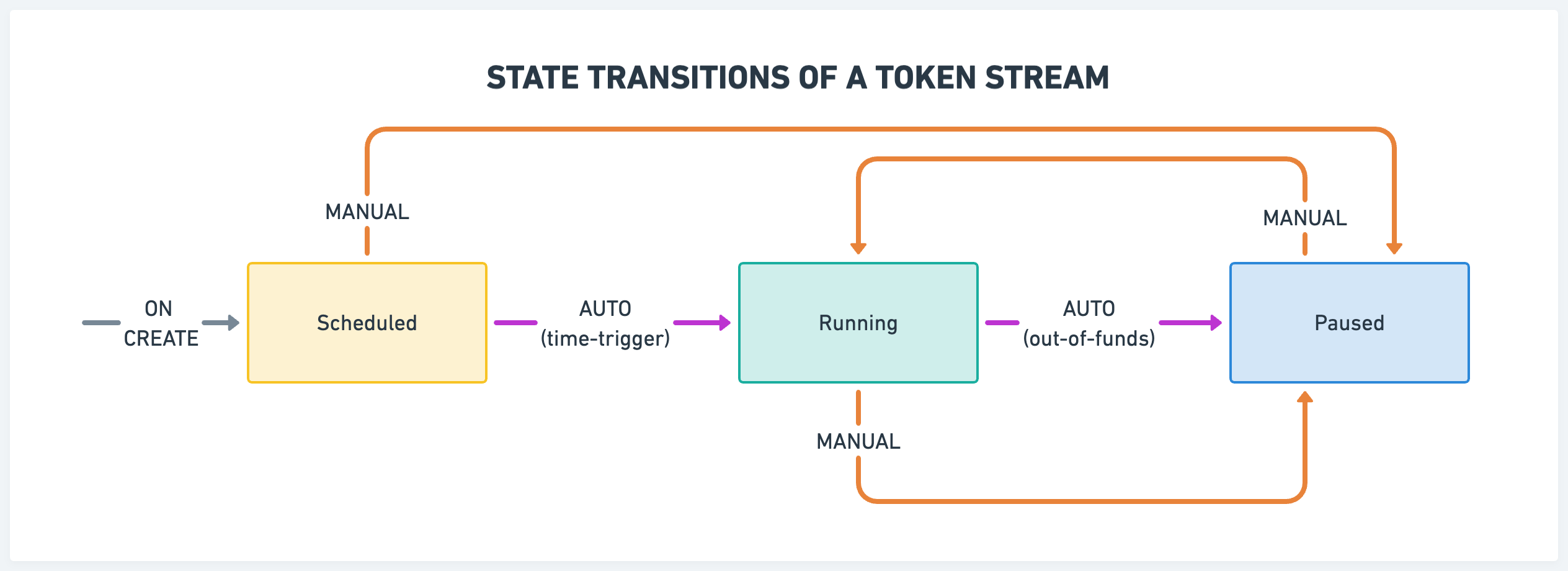
A token stream is a finite-state-machine (FSM) with the following states and transitions:&#x20;

<figure><img src="/files/1FisOpVOq76scZNLnrTf" alt=""><figcaption></figcaption></figure>

<table data-header-hidden><thead><tr><th width="156">Current State</th><th width="194">Input</th><th width="129">Next State</th><th>Output</th></tr></thead><tbody><tr><td>Current State</td><td>Input</td><td>Next State</td><td>Output</td></tr><tr><td>Scheduled</td><td>Pause CTA</td><td>Paused</td><td>Stops the token from streaming to the beneficiary. This is reversible.</td></tr><tr><td>Scheduled</td><td>Planned time arrived</td><td>Running</td><td>Starts streaming tokens from the streaming account to the beneficiary.</td></tr><tr><td>Running</td><td>Manager or Beneficiary manually stops the stream</td><td>Paused</td><td>The stream is paused, and tokens stop flowing to the beneficiary.</td></tr><tr><td>Running</td><td>Streaming Account ran out of tokens</td><td>Paused</td><td>Since there are no token to stream, the stream is stopped, and the beneficiary does not get any more tokens. This is reversible if the streaming account is reloaded.</td></tr><tr><td>Paused</td><td>Streaming Account reloaded with tokens</td><td>Running</td><td>Resumes streaming tokens from the streaming account to the beneficiary.</td></tr></tbody></table>

The token stream can be closed unilaterally and without consensus by the manager or the beneficiary. Closing a stream will result in all the vested amounts being distributed to the beneficiary and the unvested amounts, and any rent returned to the streaming account.

## **Related Works**

ERC-1620 is a protocol specification on Ethereum defining a standard for money streaming with motivations similar to those expressed here. The MSP builds upon this work to make a general-purpose protocol that can serve all time-bounded contracts, with or without a present end date and upfront locks. The specification for ERC-1620 is here: <https://eips.ethereum.org/EIPS/eip-1620>

EIP-2100 is an improvement proposal expanding some of the concepts introduced in ERC-1620 by adding options related to the settlement of the funds in the stream. The proposal for EIP-2100 is here: <https://github.com/ethereum/EIPs/issues/2100>&#x20;

Sablier Finance (<https://sablier.finance/>) is an implementation of ERC1620. The protocol focuses on the payroll use case and enforces the stream's start and end time, which is a limitation to those use cases where the end date is unknown (such as a pension fund). Sablier was launched in 2019 and, in less than 12 months, had a Total Value Locked (TVL) of over $1M, and by Jan 2021, TVL was over $100M, showing the extreme demand for this token building block.

Circle’s CEO comments on streaming payments: [https://www.pymnts.com/news/payment-methods/2021/circle-ceo-programmable-money-ushers-in-era-of-continuous-streaming-payments/ ](<https://www.pymnts.com/news/payment-methods/2021/circle-ceo-programmable-money-ushers-in-era-of-continuous-streaming-payments/ >)

## **Other Considerations**

#### **Conditional Streams**

Hourly employees get paid by the exact number of hours or minutes they work. The process works like this:

1. Employer and employee agree on an hourly rate (i.e., $20/h)
2. The employer gives the employee a way to clock in and out, like a physical clocking card at a factory.
3. At the end of the month, the employer inspects the hours reported by the employee and pays him accordingly.

To support this use case with the Token Streaming Contract, we would need to:

1. Allow the token stream to be configured with an **auto\_pause\_in\_seconds** parameter on creation, such that he/she can set this value to something like 8 hours, assuming the factory shifts are at most that long.
2. Allow the beneficiary to **ResumeStream** to signal the contract that he/she is indeed “on the clock” and, therefore, should be earning tokens from the stream.
3. Allow the beneficiary to **PauseStream** to signal the contract that he/she is “off the clock” and, therefore, should NOT be earning tokens from the stream.&#x20;
   1. This API should also allow the manager invocation for overrides in case a worker forgets to clock out or clock in.

The biggest challenge with these conditional on/off-clock triggers is the timekeeping shenanigans calculating the escrow\_vested\_amount, and the formula to calculate this field already accounts for this.

#### The Rogue Manager

**Problem**: Consider the following case.

1. A new streaming account is set up by John with one beneficiary, Alice
2. John adds a stream guaranteeing Alice a pay rate of $1,000/month
3. John then talks to contributors Bob and Jane to fund Alice’s operation through the streaming account.&#x20;
4. Bob and Jane like Alice’s project and agree to fund the streaming account with $1,000,000. Knowing Alice can only take $1,000/month, they feel they are giving the project long-term stability.
5. Now John goes rogue and secretly decides to add his accomplice Pepe as another beneficiary to the streaming account without asking Bob and Jane.
6. John sets up Pepe with a rate of $999,000 per minute.
7. The results next morning are catastrophic:
   1. John is kaput, nowhere to be found.&#x20;
   2. Alice wakes up to an empty streaming account; her project is toast.
   3. Bob and Jane lost $1,000,000 and have no project to back up.
8. This is a classic rug pull.

**Solution**: Contributors should take special care in ensuring the streaming account is managed through a multisig wallet (like [Solar Shield](/defi-protocols/solar-shield-solana-multisig)) and require a super-majority vote to add new Token Streams.


# Solar Safe Whitepaper

An on-chain smart contract for threshold multisig wallet account abstraction

## Abstract

This paper discusses the Solar Safe Multisig (a social engineering solution) to address the security trilemma of crypto assets through the use of BLS Threshold Multisigs, Smart Contracts, and MFA (multi-factor authentication) mechanisms.&#x20;

## Motivation

The current state of self-custody asset management with institutional-grade security is in its infancy across crypto. As the overall market cap of crypto continues to expand, the need for a highly secure, simple, private, and affordable self-custody solution remains elusive for crypto asset management.

We'll deconstruct in this paper a solution through Mean Multisig that will address these issues while maintaining the three basic principles that underpin its development:

1. **Security**: We handle digital assets. Security and auditing are first-class citizens here.
2. **Usability**: Batteries included; it just works; as easy as apple pie; no manual needed.
3. **Privacy:** No authority or control is set over our users. Self-custody is the standard.

Crypto custody solutions in the market today always compromise by meeting only two of these three basic tenets. For example:

* Good <mark style="color:green;">**Security**</mark> + <mark style="color:green;">**Usability**</mark> at the cost of <mark style="color:red;">**Privacy**</mark> → Coinbase, Kraken, Celsius (all custody solutions)
* Good <mark style="color:green;">**Security**</mark> + <mark style="color:green;">**Privacy**</mark> at the cost of <mark style="color:red;">**Usability**</mark> → All hardware wallets (Trezor, Ledger, etc.), and all web institutional web wallets like Fireblocks, Gnosis, Coinbase Institutional Custody, etc.
* Good <mark style="color:green;">**Usability**</mark> + <mark style="color:green;">**Privacy**</mark> at the cost of <mark style="color:red;">**Security**</mark> → Metamask, Phantom, and most popular software wallets

The primary cause for this widespread conundrum is that security-conscious wallets have come up with solutions to the security challenge from an engineering and cryptographic standpoint. Complex solutions like MPC (Multi-Party Computation) and CMP (Certificate Management Protocol) have been implemented all the way down to the chipset level. While these solutions do a lot of good from the security standpoint, their implementation is complex and creates often misunderstood processes and usability issues for the vast majority of users.

With these in mind, the aim is to deliver the next generation of self-custody asset management solutions with institutional-grade security and support for real-time finance and make it accessible and affordable for anyone to use.

## Background

Crypto asset management requires the safeguarding of a PRIVATE KEY. Whoever holds the key, holds the asset.

### Private Key Management

A private key looks like this: *<mark style="color:red;">5Kb8kLf9zgWQnogidDA76MzPL6TsZZY36hWXMssSzNydYXYB9KF</mark>*… which, clearly, is a nightmare to remember. So we, humans, decided is better to “save” it in a better place other than our brains.&#x20;

You can save it on a piece of paper, and then type that in every time you want to access your funds or make a transfer… but that’s too much typing, so you decide to send yourself an email with it in the subject line… but having to search for it every time is too time-consuming, so you save it in a Word doc with the name “BTC private key” on your desktop.&#x20;

These (really unsafe methods) were the state of crypto asset management, and therefore "wallets" for the first few years of crypto (which was no bueno, if the tone didn’t give it away).&#x20;

Then the great “mnemonic phrase” came to the rescue with the BIP39 standard and its cousins. It’s basically a bunch of words from a list of 2,048 words with certain entropy characteristics that make it statistically impossible for a random selection of them to be in the exact same order twice in the history of the universe. And so, a group of cyberpunks decided that instead of remembering this: *<mark style="color:red;">5Kb8kLf9zgWQnogidDA76MzPL6TsZZY36hWXMssSzNydYXYB9KF</mark>*… we humans are going to be sooo much better remembering this:&#x20;

<mark style="background-color:green;">involve</mark> <mark style="background-color:green;">layer</mark> <mark style="background-color:green;">staff</mark> <mark style="background-color:green;">express</mark> <mark style="background-color:green;">urban</mark> <mark style="background-color:green;">catch</mark> <mark style="background-color:green;">group</mark> <mark style="background-color:green;">congress</mark> <mark style="background-color:green;">addict</mark> <mark style="background-color:green;">behind</mark> <mark style="background-color:green;">drama</mark> <mark style="background-color:green;">reopen</mark>

I want some of what they are having, please! The idea is that these words are used as the input to a function that spits out the private key that was hard to remember in the first place, so… problem solved? 🤦&#x20;

We crypto-geniuses basically moved the problem of “private key storage” from (1) our heads to (2) the paper to (3) a digital file, to (4) a digital file + a digital program… way to go! Some people call this ***progress***.

### Crypto Wallets

Ohhh software... the solution to all our problems. Welcome to the crypto wallet orgy.

Generally speaking, a crypto wallet refers to a piece of software (usually a browser extension or a mobile app) that basically knows how to store your private key and corresponding seed phrase in the local environment where the app runs (the browser or the OS of the device where it runs, like macOS, Windows, iOS or Android).&#x20;

That’s it.&#x20;

Some are better looking than others, some have extensibility features, and some let you do basic functions like token swaps, etc, but the essence of most wallets is the same: a self-custody solution for your crypto assets.

* Passphrase <-> Private Key conversion logic, plus
* Local storage of your crypto keys.

### Custody Solutions&#x20;

Then some actual PMs and Designers saw the crypto-gurus struggling and came to the rescue with some clever solutions. ***“What if we give you a good-old username and password and WE store your complicated private key in our servers, we’ll make it simple and awesome and familiar to you dear user, and you’ll never have to worry about your private key ever again. We’ll become your Custodian”***, they said. Brilliant… everyone going bananas over Blue Labels and Caviar.&#x20;

The problem these new geniuses created was that they took risks that used to be spread across thousands of individual wallets and concentrated them into single points of attack. Now the hackers don’t need to find individual users, they can simply focus on going after these servers where companies like MtGox, Cryptopia, and Coinbase (all hacked) store thousands of private keys and hold billions of assets because they are an easier target. So now these companies need to invest millions of dollars in security, violate your privacy and charge exorbitant fees for their services, and share your information with governments and marketing partners… so, bye-bye privacy there.&#x20;

With centralized custody solutions, you risk PRIVACY and SECURITY for the CONVENIENCE of not having to deal with private keys. There is a popular saying in crypto that goes like this:&#x20;

> <mark style="color:red;background-color:yellow;">**NOT YOUR KEYS, NOT YOUR CRYPTO**</mark>

### **Hardware Wallets**

So, going back to owning your own keys… what’s next… well there’s this thing in security called multifactor authentication… let’s use it here. First, let’s break it down:

1. Single-Factor Authentication = Something you **KNOW** (like a password)&#x20;
2. Two-Factor Authentication (2FA) = Something you **KNOW** + Something you **HAVE** (like a phone)
3. Multi-Factor Authentication (MFA) = Something you **KNOW** + Something you **HAVE** + Something you **ARE** (like biometrics… fingerprint, face id, etc.)

**Higher factors = higher security. Ok, let’s do this crypto fam! → Welcome to hardware wallets. With a hardware wallet, we get to 2FA really quickly. It’s simple, here’s how they work:**

1. Buy a hardware wallet
2. Set it up with the same seed phrase with a bunch of words like we covered before, then write them down and store that in your closet. The real private key is stored in the device (that’s your 2FA)&#x20;
3. Set up a PIN with tiny physical buttons (this will be your equivalent to a password)&#x20;
4. Install a software wallet, follow 10 tutorials online, and connect it to the hardware wallet you just bought&#x20;
5. Test it and make sure it works&#x20;
6. Be miserable for the rest of your life carrying around and protecting a piece of junk that removes the joy out of your crypto experience.&#x20;
7. But sleep like a baby knowing that IF YOU CAN REALLY MAKE SURE NOBODY WILL EVER COPY THAT SEED PHRASE from #2, your assets will be safe.

Not only is this solution shitty because it is cumbersome to set up and pretty much nails it as the WORST onboarding experience of any product ever made by mankind, but in reality, it only removes the digital risks to your assets and moves that risk to the physical world.&#x20;

Good luck if you share that SentrySafe hunk of metal with your significant other who’ll no longer be so tomorrow. Fuck! Run, run, move your shit to a new hardware device, and do steps 1-7 again, and then remove all your tokens out of the old wallet into the new one before he/she makes a gangster move to wipe you out and… wait… it’s all gone!&#x20;

You just got socially engineered out of your money by an angry ex. But how is that possible?! You had what was supposed to be the safest way to guard your crypto assets.

### Smart Wallets&#x20;

Ok, that angry partner was not cool. So, a technical PM, watching his friend go through this pain, thought of a solution to fix the hardware wallet problem: Enter the SMART WALLET.&#x20;

Smart Wallets are wallets owned by a Smart Contract instead of a public key kept by you. This little nuance gives smart wallets two super-powers:&#x20;

1. **You can add all the logic and rules you want**, like account recovery process, account locks, or transfer limits per-day/per-week/per-anything-you-want-really… just like regular people are used to in any good’ol bank.
2. **You remain in control of the assets in it without the responsibility of safekeeping the private key**. This is accomplished by making one of the rules in #1 be that only certain other addresses can perform certain functions with the money in it.&#x20;

So, in essence, smart wallets separate the storage of the assets from the storage of the keys that can access these assets. You now can simply have your “access wallet” be a regular crypto wallet that holds nothing, and move all your assets to a “smart wallet” that can be accessed any time by that “access wallet” to perform operations on those assets.&#x20;

But once more, this is a technical solution to a social engineering problem. Besides the clear benefits of having a programmable wallet with a “smart wallet”, the security features are “more secure” to the extent they are more obscure.&#x20;

Security by obscurity is inversely correlated to the net worth of the assets being secured. The higher the net worth, the more interest will generate, the more malicious eyes you have in it, the less obscure it becomes, and the easier it is to exploit.&#x20;

### Social Engineering

Most security hacks on wallets are NOT the result of poorly implemented wallet security, but the result of social engineering attacks on the owner of the wallet hosting the private key, like the one orchestrated by the angry partner, or some phishing email the owner fell for.&#x20;

Therefore it stands to reason that social engineering security should be mitigated with a social engineering solution.&#x20;

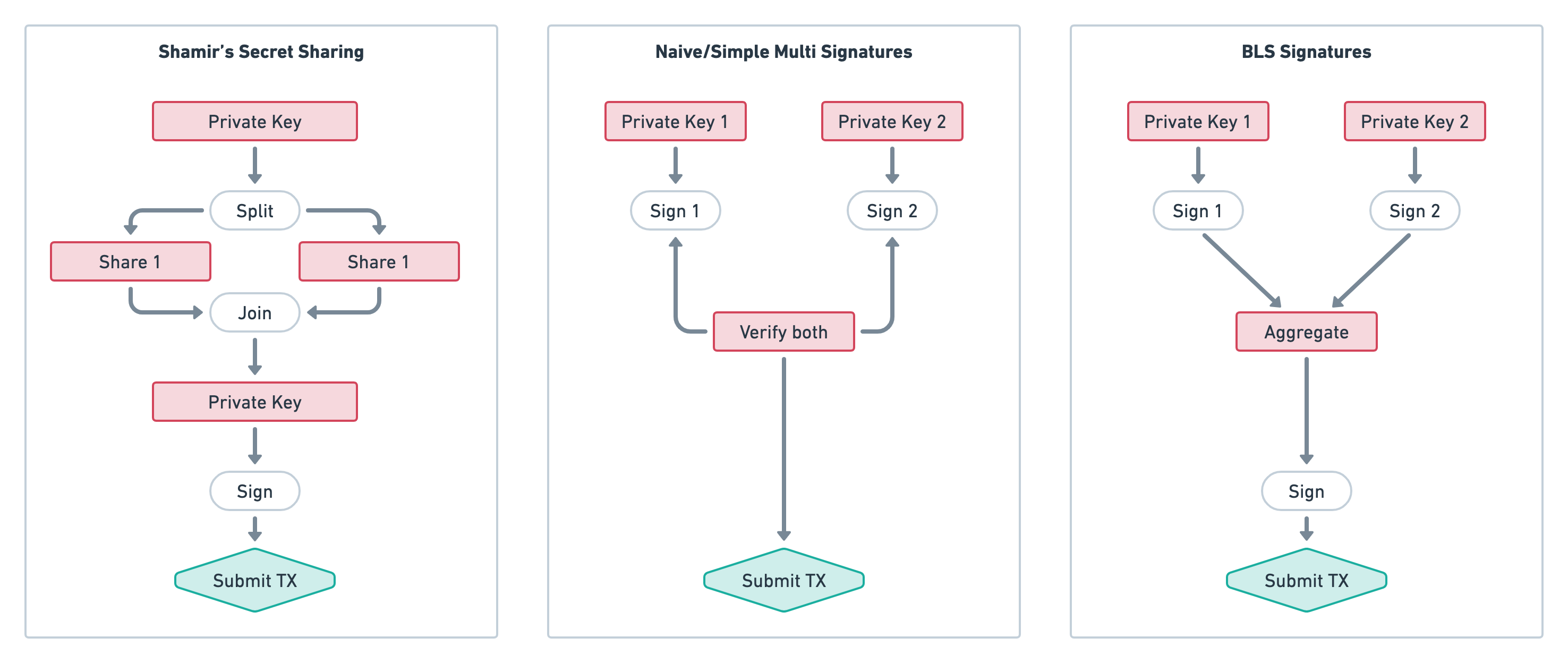
Such is the case for SSS (Shamir’s Shared Secret), BLS (Boneh–Lynn–Shacham), MPC (Multi-party computation), and Multisig solutions. Even though technically they are not the same, their motivations come from similar realizations that we need more than a single point of failure to secure assets. It is not the focus of this paper to discuss the specific implementations of each of these technologies, so we'll limit ourselves to a handy diagram:

<figure><img src="/files/QnIt4zYWiJJ3f4KBuj7z" alt=""><figcaption></figcaption></figure>

All these rely on the idea of maintaining a set of public keys or parts to verify a signature ultimately.  However, beyond the technical complications of these methods, their weakness is having a single point of failure for the entire system on any of their keys/parts.

Enter Threshold Schemes.

### Threshold Schemes&#x20;

A threshold scheme is fundamentally a social construct where to operate with assets, a consensus must be reached first by a minimum number of participants in the system (the threshold). Threshold Multisigs, Distributed Key Generation (DKG), and, more generally, Multi-Party Computation (MPC) algorithms are all forms of threshold scheme cryptography. The takeaway is that if someone loses their keys or is away on vacation, we can still sign.&#x20;

Proof of work and proof of stake blockchains are massive threshold schemes asking hundreds of thousands of nodes and validators to sign when they agree with a transaction. The Bitcoin network is the most attacked in the world and has yet to suffer from a single breach of this algorithm since its inception in 2009.&#x20;

### Threshold Multisig

A threshold multisig, as the name suggests, will have multiple signers (aka owners), and a minimum number of them (the threshold) must sign in order to execute transactions. This is usually referred to as n/m multisig, where **n** is the threshold required out of the **m** owners that can sign for the multisig.&#x20;

Hacking a multisig requires coordinated social engineering attacks that are time-sensitive and operationally complex. It is the hardest to pull off, and besides serving as a deterrent for hackers, it is impossible to accurately identify all owners at the same time and have them react in the same way to the planned attack.&#x20;

## Solar Safe Multisig&#x20;

Even though threshold multisigs are a massive improvement in security over their technical counterparts, they lack the simplicity and familiarity of MFA and the flexibility of the logic of smart contracts.&#x20;

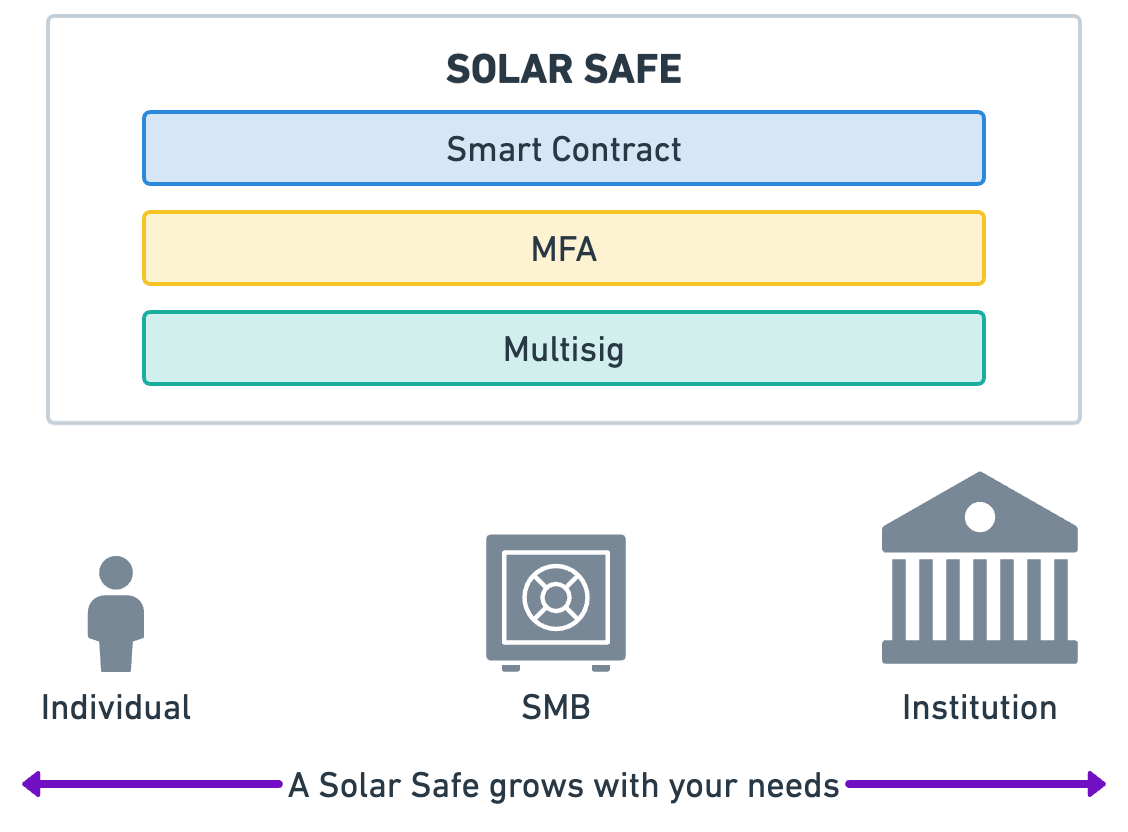
We propose combining a specific set of these technologies, specifically Smart Contracts, BLS, Threshold Multisigs, and MFAs, to bring a Solar Safe Multisig to life. With clever UX and the right technology combo, we are ticking our three core tenants for self-custody asset management:&#x20;

* <mark style="color:green;">**Security**</mark>: Driven by the Mean Threshold Multisig, BLS, Smart Contract Accounts/Wallets, and MFA, hacking a Solar Safe Multisig wallet becomes exponentially challenging as the attacker will need to perform social engineering and technology penetrations on more than one person across multiple devices to execute a malicious transaction.
* <mark style="color:green;">**Usability**</mark>: The easiest way to think about the usability of a Solar Safe Multisig is like a Business Bank account (think Brex, or whatever you consider the best banking experience you’ve ever had for a business). In this “business” setting, a set of owners/authorized personnel can configure a set of rules and policies for the Solar Safe Multisig, such as expenses, limits, account locking, etc., for each of the people in the organization, therefore limiting beforehand the worst-case scenario in the case anyone gets compromised.
* <mark style="color:green;">**Privacy**</mark>: Across the different technologies leveraged for Solar Safe Multisig, privacy is at the core of all of them. The Mean Multisig is 100% DeFi without any centralized infrastructure. The MFA security around it has a minimal centralized infrastructure blueprint to support multisig MFA for the Solar Safe Multisig, mainly through on-device biometric verification (FaceID, TouchID, etc.) or 3rd party authenticator apps (Google Auth, Authy, etc.) or traditional communication infrastructure (email and SMS). Solar Safe keeps privacy as a core tenant with no KYC/B, no custody, and no login required.&#x20;

A Solar Safe Multisig also offers an incredible solution to complex asset management, like account delegations, social account recovery with guardians or witnesses, dead man’s switch workflows for asset legacy and inheritance, and more, all through the simple concept of security via social engineering afforded via multisigs.

<figure><img src="/files/gveIufrm4YgEjeMNHCRR" alt=""><figcaption><p>Solar Safe Components</p></figcaption></figure>

{% hint style="info" %}
We know you want more details, more specs about Solar Safe Multisig, the formulas, the design, the architecture, more, more, more.&#x20;

We are, however, the kind of team that doesn't do well with premature promises. We prefer identifying a really big problem, proposing a solution (like we did here), and iterating on it as we build it. As we do these iterations and details about the final implementation become clearer and more concrete, they will be added here.&#x20;
{% endhint %}

## Summary

In this whitepaper, we covered how the importance of self-custody asset management, the state of cryptographic solutions and their complexity, the security trilemma, and other industry challenges related to crypto assets custody.&#x20;

We also explored what a Solar Safe Multisig is, and how it leverages BLS, Threshold Multisigs, MFA, and Smart Contracts (Programs in Solana) to deliver the next generation of self-custody asset management solutions with institutional-grade security and support for real-time finance and make it accessible and affordable for anyone to use.


# Safety & Security

Mean Protocol safety and security is always front and center

## Safety

DeFi is a brand new space; with each new frontier comes its associated risks. We advise care, caution, and a necessary curiosity while interacting with DeFi protocols.&#x20;

This section details the risks involved with using Mean Finance and some risks associated with the underlying services it gives access to. Please keep in mind that this page does not consider Solana network-level risks.

{% hint style="danger" %}
**This page is not an official nor a legal-binding statement.**&#x20;

It's user-focused documentation of the risk involved with the use of Mean Finance and the underlying protocols it provides access to. &#x20;
{% endhint %}

#### **Who holds your tokens?**

The users control all funds through their wallets and private keys. Mean Finance is a self-custodial set of applications and smart contracts and does not have access to spend the funds in the wallets. There are zero risks of losing funds from interacting with MeanFi if your funds are in your wallet.&#x20;

## Transparency

Decentralized Finance means complete transparency through digital smart contracts on public ledger blockchains. Check more details about the Contract Address and Fees [here](broken://pages/-MhoYwx8qZVMQIfrwxuj#smart-contracts).

**PERMISSIONLESS**: People and businesses require no permission from any company, government, or institution to interact with the Mean Protocol. You can interact with the MEAN PROTOCOL MAINNET smart contracts at any time or explore the code directly on the [GitHub](https://github.com/mean-dao/mean-core) repo to get started.&#x20;

**TRUSTLESS**: People and businesses do not need to identify themselves with the Mean Finance ecosystem of protocols and applications. That means no KYC, name, password, or centralized account management. Trustless also means you don't have to trust what we promise. Since these open-source apps and smart contracts are deployed into Solana's mainnet, anyone can contribute and inspect the code they are interacting with on [GitHub](https://github.com/mean-dao/mean-core). &#x20;

**NON-CUSTODIAL**: We don't ever have access to or custody of your money. You always control your money in a self-custody way and through your preferred wallet (see [Solana's Wallet Guide](https://docs.solana.com/wallet-guide)). So long you are in control of your keys, you are in control of your money. Our smart contracts and apps help you manage your money more efficiently while maintaining your privacy and control over those funds.&#x20;

## **Risks**

**Smart Contract / Program Risks**

As developers, we try our best to write safe code and do internal and external code reviews and audits by auditing firms. We have a strict implementation of code coverage for on-chain programs that must pass 100% before being deployed to production, and we perform penetration testing regularly on our web application.&#x20;

However, we do want to remind our users that issues could arise due to human error, and you should be aware that you are abiding by our Terms of Service by asserting you understand these risks.

**Oracle Risks**

We have price oracle redundancy between Chainlink and Pyth oracles. Even though this mitigates single-oracle spoofing attacks and DDOS attacks on their networks, under certain extreme market conditions, pricing data could be corrupted on BOTH oracle networks and, therefore affect the execution runtime of our DCAs. The risk of this happening is low, but if it did happen, it could trigger a swap that results in a potential loss of funds for the user.

## Audits

Mean Finance smart contracts use the Semantic Versioning 2.0 standard (SEMVER). Different versions receive different security audits according to our Security and Auditing Framework:&#x20;

<figure><img src="/files/RhwWbcVnGupGPCjrKe9o" alt=""><figcaption><p>Mean Finance Security &#x26; Auditing Framework</p></figcaption></figure>

{% hint style="info" %}

#### NOTE&#x20;

#### The MEAN governance token uses Solana's SPL Token Standard, and it does not rely on a custom contract. Refer to the [Solana Security Audit Report](https://solana.com/solana-security-audit-2019.pdf) for details on the SPL Token Program.&#x20;

{% endhint %}

#### Soteria's Audit Report

Soteria is one of the top Security and auditing firms servicing Solana, with some of the top minds in software and blockchain security research and practice. Their team of experts has over ten years of development of rigorous automated verification and patented technology powered by mathematical proofs and maximal concolic execution.&#x20;

Download the Soteria Audit Security Report on Mean Protocol below:

{% file src="/files/UKjnAWALxtqFQNzSMjND" %}

#### Certik Audit Report

CertiK is a pioneer in blockchain security, utilizing best-in-class AI technology to secure and monitor blockchain protocols and smart contracts. CertiK's mission is to secure the cyber world.&#x20;

Download the Certik Audit Security Report on Mean Protocol below:

{% file src="/files/THEevWARfWWFJARQ0Qei" %}

#### Additional Security Procedures

Security is a continuous effort that goes hand in hand with new product development, features, and improvements across our smart contracts.  We continuously evaluate our security measures with continuous code reviews, unit tests, integration tests, code coverage, bug bounties, and penetration tests.

## Multisig

Mean Protocol's programs are owned, deployed, and upgraded through a 3/5 multisig account:

* Programs MultiSig: 8RbALxTJZKK2q267ypXy7EyWckLBmZpnNpuCCcsqJvvn &#x20;

All Mean DAO Treasuries are also managed through multisig accounts, as defined below:

* Treasury MultiSig: Ffm9iByvunbBBkXXnBe6rz7UjLNaeq3VcAwaoZfkEJhw


# Developers Guide.


# MeanDAO

The DAO organizing Mean Finance's open protocols and community

## DAO Genesis

The Mean Finance Ecosystem formed MeanDAO on Dec 24th, 2021, with the objective of supporting the public goods protocols developed by the core team, namely the Token Streamer (aka Payment Streaming protocol) and the Solar Safe (aka Mean Multisig).

The core team relegated control of those protocols' parameters and revenue drivers to the DAO Governance and re-stated their alignment with the overall Mean Finance Mission.&#x20;

## One Metric

As a fully Decentralized Autonomous Organization with membership across the world and with products exclusively in the Solana Ecosystem, the DAO further focused its mission on a single metric:

{% hint style="success" %}
Onboard and grow **business operational payments token volume** in Solana DeFi
{% endhint %}

Let's break that apart back to front.

1. **DeFi** = <mark style="background-color:green;">focused on</mark> DeFi, full-stop
   * &#x20;This also means <mark style="background-color:red;">not focusing on</mark> collectibles, games, etc.
2. **Solana** = <mark style="background-color:green;">focused on</mark> Solana DeFi, full-stop
   * This also means <mark style="background-color:red;">not focusing on</mark> Ethereum, Polygon, Bitcoin, etc.
3. **Token Volume** = <mark style="background-color:green;">focused on</mark> Solana DeFi Token Volume, full-stop
   * This also means <mark style="background-color:red;">not focusing on</mark> TVL, On/Off Ramp and Bridge Volume, # of Users, etc
4. **Business Operational Payments** = <mark style="background-color:green;">focused on</mark> business use cases with lots of volumes, like Payroll, Token Vesting for VCs, Business Loans, etc.
   * This also means <mark style="background-color:red;">not focusing on</mark> non-operational volume, like trading volume, P2P volume, remittance volume, etc.
5. **Onboard and Grow** = <mark style="background-color:green;">focused on</mark> bringing volume from newly onboarded businesses and growing volume from existing ones.
   * This also means <mark style="background-color:red;">not focusing on</mark> retail/individual users' volume.

## High Signal, Low Noise

The MeanDAO was formed during one of the worst periods of the crypto markets and was directly affected by some of its investors, who turned out to be bad actors. Our dear MEAN token and our  Treasury suffered when Three Arrows Capital went under, then when Defiance went under, and then one last time when Alameda/FTX went under. But we persevered and kept on building because our mission is worth keeping alive for the world because what we are doing matters on a human scale.&#x20;

Because we survived the school of hard knocks, we are unwavering in maintaining hyper-focus on the overall Mean Finance mission and filtering every idea and every move through the lens of that mission and our one metric. An idea should not be considered if it doesn't improve one of those two unless the proposal is to change our guiding principles and metric.&#x20;

Time is limited, and we vow not to waste ours on things that do not have a high probability of improving our <mark style="background-color:yellow;">**One Mission x One Metric**</mark>.&#x20;

{% hint style="success" %}
**Mean Finance Mission:** To accelerate the world’s transition to decentralized finance ecosystems to bring economic equality and opportunity for individuals and organizations everywhere.

**MeanDAO Metric**: Onboard and grow business operational payments token volume in Solana DeFi.
{% endhint %}

## Founding Team

‌MeanDAO was founded by five long-term software entrepreneurs, cryptocurrency investors, and friends. They were Michel, Eydel, Yamel, Yansel, and Maylin. Joined by an enthusiastic community, we ventured into the unknown to build together and share ownership in the belief that meaningful value can be created when an ecosystem collaborates to build vs compete.&#x20;

As of Nov 2023, the MeanDAO is made of people from all corners of the world, and we are made of 12k+ MEAN token holders, over 1k sMEAN stakers and governance signers, and 54 active members who have submitted proposals directly on-chain.

## Known Investors

As a DAO, ownership is established by our token holders; and we have been fortunate to have the support of world-class investors and advisors, led by SoftBank, BigBrainHoldings, Gate.io, and DeFiance Capital, and others that will go down in history as the troubled ones, such as Three Arrows Capital and Alameda Research.&#x20;

Read our private round announcement [HERE](https://medium.com/mean-dao/mean-dao-brings-world-class-investors-onboard-to-revolutionize-the-banking-sector-and-build-the-c8bd4b7ed89b).

<figure><img src="/files/kNIS0Gzje9Yu3eHcm6ti" alt=""><figcaption></figcaption></figure>


# Governance & Voting

MeanDAO governance helps determine the future of the organization and its protocols

Governance is the collective and decentralized decision-making process on specific rules and directions for MeanDAO. Given we are a protocol DAO that makes products, the governance proposals are geared toward code maintenance, roadmap, and future releases of the protocols and products we support with our Treasury resources.

## General Primer

The following points will allow you to understand governance and the forum better.

Respectful and good-faith discussions should be the cornerstone of any decision-making process. In trying to enact change, please keep this principle in mind.

MeanDAO’s governance has components on-chain (Voting Portal on Realms) and off-chain (Proposals Forum on Discord).&#x20;

## Proposals Forum (Discord)

Community-driven discussions, well-reasoned arguments, and voting in this forum can all influence the protocols without the need for tokens. Here are some tips on navigating the forum:

1. Each category has a pinned ‘About’ post with useful resources.
2. The ‘Latest’ tab will show you the most recent conversations.
3. Feel free to introduce yourself in the Welcome or General channels.

## Voting Portal (Realms)

[MEAN ](broken://pages/-MlWK7n9WH8Vn9G-AHbu)is the governance token whose ownership grants voting rights on proposals to dictate MeanDAO's protocols. Always do your research when voting.&#x20;

The official Discord has a Proposals Forum to openly discuss ideas before voting.

When a proposal has matured enough and has a lead, it moves to the Voting Portal for on-chain voting. The voting governance portal for MeanDAO is hosted on [Realms](https://app.realms.today/dao/MEAN).

## **The process of submitting a proposal**

MeanDAO members can submit a proposal ranging from the improvement of the Protocol to improving the community's health and the token to attract new developers and growth, to name a few. \
\
The steps are pretty simple, as mentioned below:

1. Start by discussing your ideas on the [General Chat](https://discord.gg/Zetqw69V) of the MeanDAO Discord&#x20;
2. As the idea gains momentum and traction and has a more defined structure, one can move it to the [Proposals Forum](https://discord.gg/dhfkqmhD) (also on Discord) with its own topic.
3. Get the token holders and DAO members involved early in the conversation to ensure that the draft and submitted proposal follows the DAO's guidelines and goals.
4. Once you feel there's enough support from community members and token holders in the Forum, it's time to submit the proposal for vote on Realms.
5. Congratulations! Your proposal is now submitted.&#x20;

There are circumstances where a proposal might be rejected or declined due to various reasons. Some of them are listed below:

* Lack of clarity (i.e. poorly written, little scope, etc.)
* Lack of ownership (no one is taking ownership over the deliverables)
* Missing KPI to measure success against
* Missing information such as timeline, deliverables, budget

Having a proposal declined is not a sign that a DAO member should not show active participation in the construction and delivery of a proposal. Rather, it is just a learning curve to improve on those proposals and to present better, clearer, and well-articulated ones.&#x20;


# Gov Token (MEAN)

Tokenomics for $MEAN

## What is the $MEAN token?

MEAN is the governance token of the MeanDAO. It allows those who hold it to vote on changes in the Community Treasury and the MeanDAO protocols.&#x20;

The token is deployed on the Solana Blockchain as an SPL Token. The ongoing audits for the SPL Token smart contract and related on-chain programs can be found [HERE](https://github.com/solana-labs/security-audits).&#x20;

Additional details about the deployed token parameters are below:&#x20;

* **Symbol**: $MEAN
* **Type**: Solana SPL Token
* **Total Supply**: 210,000,000&#x20;
* **TGE**: Dec 24th, 2021
* **Purpose**: Governance
* **On-Chain**: [View on Solscan](https://solscan.io/token/MEANeD3XDdUmNMsRGjASkSWdC8prLYsoRJ61pPeHctD)

## Token Stats

These are the on-chain stats for $MEAN as of Q4-2023:

* Token Holders: 13,092
* Current Supply 209,999,527.64 (the rest have been burned)
* Market Cap $6,960,820.74 &#x20;
* The top 10 holders collectively own 125,517,241.83 Tokens (59.77%)
* For the most up-to-date info, see [$MEAN on SOLSCAN](https://solscan.io/token/MEANeD3XDdUmNMsRGjASkSWdC8prLYsoRJ61pPeHctD#analysis)

**Known-Addresses amongst top-10 holders**

<table><thead><tr><th width="317">Address</th><th width="163">$MEAN Balance</th><th>Description</th></tr></thead><tbody><tr><td>E4zKMnJC6E7p7izgynpKXubJiXeDNvohjVunbTgxN6jh</td><td>29.0M (~13.8%)</td><td>Official DAO Treasury</td></tr><tr><td>6RiJ9gbjrBXt3ieBD7UBWaa4gpLNL8S427DEZ5Y8MMGF</td><td>23.4M (~11.2%)</td><td>Unknown Address</td></tr><tr><td>4CUSb4s7T9VTfv6Ti9EFEqiiZJbV3ZpXhNTYiYMveVZW</td><td>14.4M (~6.9%)</td><td>Unknown Address</td></tr><tr><td>GMG74Wi8Mj4KpS6qxUgcofBSNMa8qkqtVgtUc3g5sPpF</td><td>13.6M (~6.5%)</td><td>Unknown Address</td></tr><tr><td>u6PJ8DtQuPFnfmwHbGFULQ4u4EgjDiyYKjVEsynXq2w</td><td>9.8M (~4.7%)</td><td>Gate.IO Exchange</td></tr><tr><td>E4zKMnJC6E7p7izgynpKXubJiXeDNvohjVunbTgxN6jh</td><td>8.0M (~3.8%)</td><td>Core Dev Team Treasury</td></tr><tr><td>H5qHuW3S497CVp31yQhSYdWBPBp33kUtpCJS6QjfP6B7</td><td>7.7M (~3.6%)</td><td>Unknown Address</td></tr><tr><td>H8DrTeTDfUFT5zXf98DuQeAh5Nu25Eq6cyhW533SvwKk</td><td>6.9M (~3.3%)</td><td>Unknown Address</td></tr><tr><td>6ay1Ub6vcyBnEoug3Tod8f3VpAW52dtVjFRYSzxM8LAH</td><td>6.4M (~3.1%)</td><td>Unknown Address</td></tr><tr><td>51HpTxzERCvW7EPeWffDpdK5EkRD2yMyF4UKc81vMSYY</td><td>5.7M (~2.7%)</td><td>Community Development Grants</td></tr></tbody></table>

## Allocations & Distributions

<figure><img src="/files/7OMUhcvJ7aIc2zb9CLUB" alt=""><figcaption><p>MEAN Token Allocations and Distributions</p></figcaption></figure>

### **Community & Rewards (70%)**&#x20;

The lion's share of MEAN tokens will go to the community. We want MeanDAO to be owned and run by the community invested in the mission of the overall ecosystem. Below is the breakdown of how MEAN tokens will be distributed to the community.

#### → Community Treasury (40%)

These are MEAN tokens owned by the community. The community can vote on how to use these tokens.

The Community Treasury will have a stepped linear vesting schedule at every Solana block over three years, starting on the Token Generation Event in line with the schedule below:

* **Year 1**: 50% of the treasury tokens vested
* **Year 2**: 30% of the treasury tokens vested
* **Year 3**: 20% of the treasury tokens vested

#### → Initial Rewards & **Incentivized Programs (30%)**

This program will run for two years from TGE and will cover

1. Retroactive rewards&#x20;
2. Staking incentive rewards&#x20;
3. Liquidity mining programs

Liquidity mining incentives are deployed directly through the AMMs, where liquidity is provided. These are likely to be moving targets as different collaborations are finalized with the different Solana AMMs. At TGE, our launch AMM partners are Orca and Raydium, with long-term commitments to pools and farming rewards.  &#x20;

### **Team & Advisors (20%)**&#x20;

Team allocations are set aside for founding team members. They provide direction to the network in its early stages and maintain and upgrade the codebase following governance votes.&#x20;

Team and advisor allocations have a waiting period of 6 months after TGE, are vested over 48 months linearly, and can be stopped by governance votes if the team does not perform accordingly.

### **Token Sale (10%)** &#x20;

Use of Funds:

1. **Bootstrapping Liquidity (50%) →** Depending on the market, up to 50% is reserved for bootstrapping on-chain liquidity across various pools with no less than $250k/pool.
2. **Contract Auditing (10%) →** Ongoing auditing for the Token Streaming and Multisig protocols is budgeted at 10% of the token sale proceeds.
3. **Growth/Marketing (10%) →** There’s a heavy education and content component on the approach we need to take to grab the market’s attention.
4. **Development (20%) →** We have an extensive roadmap and need additional help with product development resources. We must fund the devs to let them focus on building without stress for 12-18 months.&#x20;
5. **Partnerships (10%) →** Getting listed in CEXes and penning strategic partnerships.

## Using MEAN

Here's an overview of some of the things MEAN holders can do with their tokens.&#x20;

<figure><img src="/files/CyG8pUtmMN5mJepkzkX1" alt=""><figcaption></figcaption></figure>

Note that most of these protocols are permissionless, and neither MeanDAO nor its members have control over them. Please exercise caution when interacting with other smart contracts. This is not an endorsement of any of these programs or teams, and it's here to serve for informational purposes only.&#x20;

### Reports & Stats

| Token Info                                                    | Token Stats                                                                                                       |
| ------------------------------------------------------------- | ----------------------------------------------------------------------------------------------------------------- |
| [CoinGecko](https://www.coingecko.com/en/coins/meanfi)        | [On Solscan](https://solscan.io/token/MEANeD3XDdUmNMsRGjASkSWdC8prLYsoRJ61pPeHctD)                                |
| [CoinMarketCap](https://coinmarketcap.com/currencies/meanfi/) | [On SolanaFM](https://solana.fm/address/MEANeD3XDdUmNMsRGjASkSWdC8prLYsoRJ61pPeHctD?cluster=mainnet-solanafmbeta) |
| [Coinbase](https://www.coinbase.com/price/meanfi)             | [On Solana Explorer](https://explorer.solana.com/address/MEANeD3XDdUmNMsRGjASkSWdC8prLYsoRJ61pPeHctD)             |

### Token Addresses

The MEAN token is a multi-chain token available in four(4) chains. The primary chain is Solana, and the token is bridged through Wormhole to Ethereum, BNB Chain, and Polygon. These are the official token addresses on each of the chain smart contracts:

<table><thead><tr><th width="136.33333333333331">Blockchain</th><th width="471">MEAN token address</th><th>Explorer Link</th></tr></thead><tbody><tr><td>Solana</td><td>MEANeD3XDdUmNMsRGjASkSWdC8prLYsoRJ61pPeHctD</td><td><a href="https://solscan.io/token/MEANeD3XDdUmNMsRGjASkSWdC8prLYsoRJ61pPeHctD">Solscan</a> </td></tr><tr><td>Ethereum</td><td>0x9b25889C493aE6Df34cEef1ecb10D77c1Ba73318</td><td><a href="https://etherscan.io/token/0x9b25889c493ae6df34ceef1ecb10d77c1ba73318">Etherscan</a></td></tr><tr><td>Polygon</td><td>0x4867B60aD7C6aDc98653f661f1AEA31740986bA5</td><td><a href="https://polygonscan.com/token/0x4867b60ad7c6adc98653f661f1aea31740986ba5">Polygonscan</a></td></tr><tr><td>BNB Chain</td><td>0x6C9297BE2e3Ce9C10c480A25B7157A43FD992942</td><td><a href="https://bscscan.com/token/0x6c9297be2e3ce9c10c480a25b7157a43fd992942">BscScan</a></td></tr></tbody></table>

#### How to move (bridge) MEAN from one chain to another

1. Go to Portal Bridge ([https://www.portalbridge.com](https://www.portalbridge.com/))
2. Select Source and Destination chains
3. Select MEAN in the token drop-down
4. Approve transaction for Source Chain (i.e., Solana) with Source Wallet (i.e., Phantom)
5. Approve transaction on Destination Chain (i.e., Polygon) with Destination Wallet (i.e. Metamask)

### Token Markets

<table><thead><tr><th width="373">Central Exchanges</th><th>DEXes</th></tr></thead><tbody><tr><td><a href="https://www.gate.io/trade/MEAN_USDT/?ch=en_sm_1221">Trade on Gate.io</a></td><td><a href="https://app.meanfi.com/exchange">Trade on MeanFi DEX</a></td></tr><tr><td><a href="https://www.bitmart.com/trade/en?layout=basic&#x26;symbol=MEAN_USDT">Trade on BitMart</a></td><td><a href="https://www.orca.so/">Trade on Orca DEX</a></td></tr><tr><td><a href="https://m.mexc.com/trade/spot-kline#MEAN_USDT">Trade on MEXC</a></td><td><a href="https://raydium.io/swap/?inputCurrency=sol&#x26;outputCurrency=MEANeD3XDdUmNMsRGjASkSWdC8prLYsoRJ61pPeHctD&#x26;outputAmount=0&#x26;fixed=in">Trade on Raydium DEX</a></td></tr><tr><td><a href="https://latoken.com/exchange/MEAN-USDT?UTM_source=coinmarketcap">Trade on LATOKEN</a></td><td></td></tr></tbody></table>

## FAQs

### How can I get MEAN tokens?

* Buy it using USD/EUR directly on [MeanFi](http://app.meanfi.com/buy) using the deposit function.
* Buy it or trade it at an exchange:
  * On MeanFi: <https://app.meanfi.com/exchange?from=USDC&to=MEAN>
  * On Gate.io: <https://www.gate.io/trade/MEAN_USDT>&#x20;
  * On Bitmart: <https://www.bitmart.com/trade/en?symbol=MEAN_USDT>&#x20;
* Exchange it with other people (P2P) directly.

### What can I do with MEAN?

Trade ir and stake it to earn voting power and take part of governance on the future of the MeanDAO.&#x20;


# Staked MEAN (sMEAN)

How to stake MEAN and leverage sMEAN tokens

$MEAN token holders can increase their governance power and distribution allocations by staking their tokens into Stakes MEAN (sMEAN) tokens. sMEAN staking rewards include emission incentives and a share of the protocol revenues.&#x20;

## How to stake MEAN?

When you stake MEAN, you receive sMEAN in return. sMEAN represents a claim on MEAN staked in the staking vault.&#x20;

sMEAN is an SPL token that is movable and tradable, making MEAN staking a fully liquid staking solution with 100% capital efficiency while maintaining your governance rights and benefits as a MEAN token holder.&#x20;

The amount of sMEAN you receive when stake MEAN is calculated based on the price difference between sMEAN and MEAN. The price of sMEAN is determined by the total MEAN in the pool over and above the amount staked. This price will grow as more emissions and fee revenue are deposited into the staking vault.&#x20;

The greater your sMEAN holdings, the greater your Mean Voting Power; with that, your say in MeanDAO's governance.

## Claiming staking rewards

MEAN Staking is a liquid form of staking, just like Lido's stETH or Marinade's mSOL staking. When you stake mean and receive unlocked sMEAN, you do not need to 'claim' your rewards, as they will be distributed to you when you unstake. On top of getting back the MEAN you staked, you will also receive a share of the fees and emissions added to the staking vault (as extra MEAN). The longer you leave your MEAN staked, the more MEAN you will make.

## Locking sMEAN

In an upcoming release of the MEAN staking program, the DAO plans to offer locking periods you can use to boost your rewards. Staking MEAN will then involve locking your tokens for a predetermined time in the staking contract.&#x20;

MEAN holders are incentivized to lock their MEAN for two primary benefits: to boost their voting power and to earn a more significant share of the revenues. There are both short and long locking time-frames from 7 days to 4 years to choose from. The longer a user locks their MEAN tokens, the more significant the boost they receive. While your tokens are locked, they cannot be unlocked or transferred by users. Please be mindful of this and plan accordingly to navigate market conditions.&#x20;

## Distributions

If you stake and lock your MEAN for 30 days or more, you become eligible for revenue distributions paid in MEAN and distributed automatically every Wednesday from the community treasury.&#x20;

The protocol distributes 40% of the revenues allocated to the repurchase program directly to MEAN stakers in the form of dividends. The distribution is relative to how many MEAN tokens each user has staked as a percentage of the entire MEAN stake. The larger your percentage, the more significant your distribution allocation.